


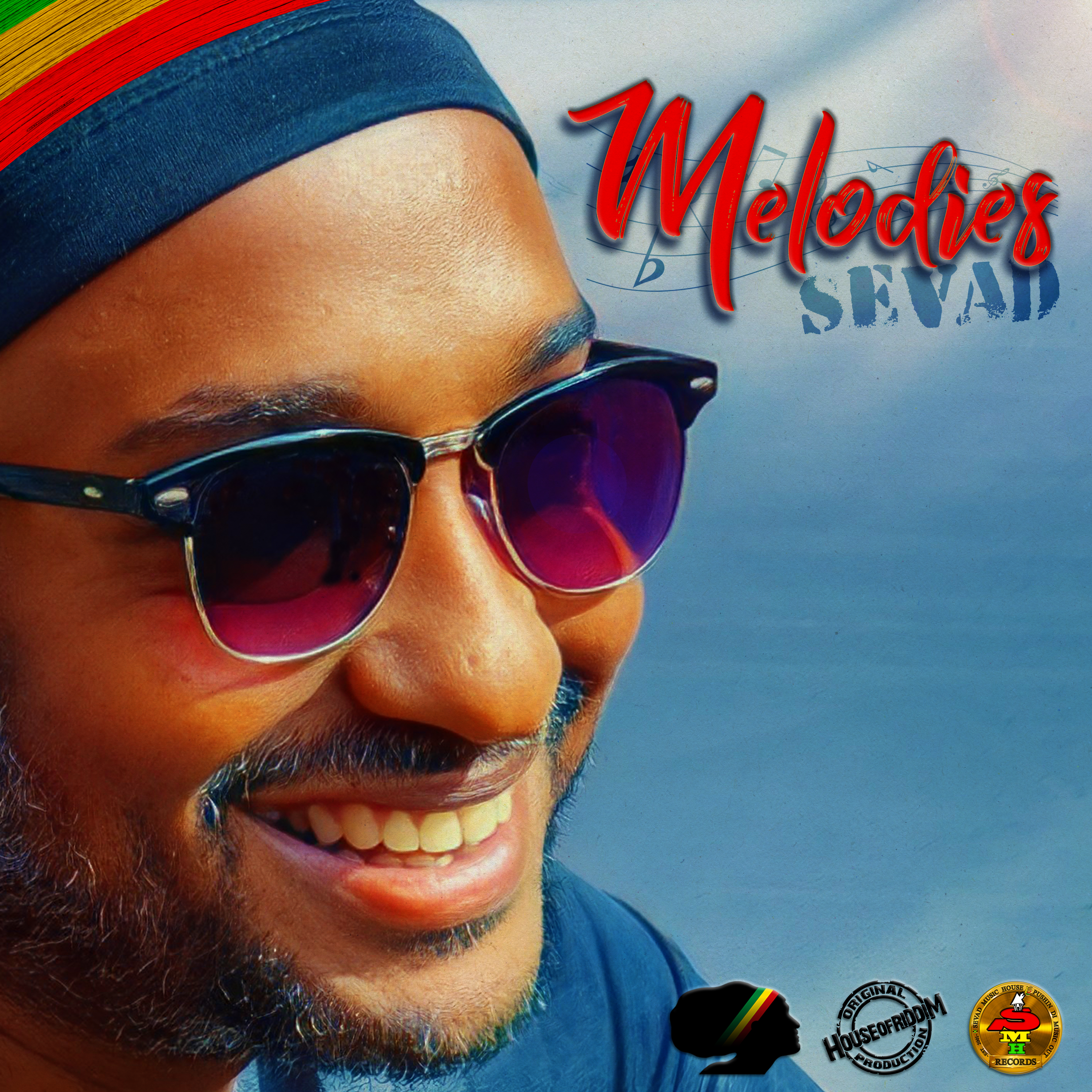

SEVAD: Music, Ownership, and the Independent Journey
A Jamaican-born reggae artist and founder of SEVAD MUSIC HOUSE—building his career in real time while helping other artists build theirs.
SEVAD is Steven Davis — a Jamaican-born independent reggae artist, singer-songwriter, performer, producer, author, educator and creative entrepreneur, based in Frankfurt, Germany.
Twenty-five years of releasing records without a label. This is how that happened.
HE SANG BECAUSE HE COULD NOT SPEAK
His mother raised him alone, and poverty was never far from the door. She led the choir at her church and was its vocal teacher, and he got his love of music from watching her do it. She taught him to sing and to play the piano — playing him each note so he could hear the pitch and match it. She raised him on soul: Sam Cooke, Nina Simone, Marvin Gaye, the whole Motown catalogue.
He needed those lessons more than most children did.
“I stuttered very badly as a child. Yet I found that when I sang, I didn’t stutter. So I used to sing instead of speaking.”
He stuttered so badly that he stopped trying to talk. Then he found the one place it disappeared, and he went there and stayed. People started asking his mother whether the boy could sing at their parties, and by then it was already settled.
Music was not a passion he picked up. It was how he communicated at all. The stutter is gone now, apart from a trace when he is very nervous.
That is the first closed door, and it was his own mouth. Everything that follows is the same answer to the same problem: find another way to be heard.
BUT FIRST HE WAS A DANCER
By the early nineties he was on the Jamaican stage-show circuit — and not as a singer.
He was a dancer, and he was paid to dance. He could always sing, and the people around him knew it. But dancing was where the girls were, and he was young, and the girls loved it, so that is what he did.
One man kept telling him he had it the wrong way round.
1994 — MIDWAY MALL
Garnett Silk was around him and his mother in those years. Somebody he knew, not somebody he watched from a distance. And Silk had been telling him the same thing for as long as they had known each other.
“Yo, you should sing. Stop this dancing bullshit and sing. You’re a singer, not a dancer.”
On the night of 9 December 1994 they were on the same bill at Midway Mall in Mandeville — Garnett Silk, Sizzla, Luciano, and a young dancer being paid to dance.
They spoke that night.
Then Silk left to go and check on his mother and on his house. He was building it, the materials were stacked there, and people had been stealing them.
He did not come back.
At three in the morning, still at the show, SEVAD’s phone rang. It was his mother. She had heard it on the radio and wanted to know where Garnett was. He went straight to the house.
He stopped dancing after that night, and he started singing. And he came to Rastafari.
“So everything changed right here. 1994, Midway Mall. Never forget that night.”
The last thing Garnett Silk ever said to him was that he was a singer. Neither of them knew it was the last thing.
THE ROOMS THEY THREW HIM OUT OF
He grew up in Jamaica before home studios existed. No affordable computers, no Pro Tools, no way to make a record except to walk into a professional studio with money he did not have.
The first people to tell him he was not good enough were in those studios. He was chased out of them.
So when computers finally arrived, he taught himself Pro Tools and started recording in his bedroom. They closed the door; he built his own room.
Then the next problem. The ideas came at one in the morning and there was nobody to call.
“I didn’t learn to mix because I wanted to be an engineer. I learned because nobody else was going to do it for me.”
He learned to record himself. His engineer left, he could not afford another, so he learned to mix. Nobody would give him a beat, so he learned to build them. It was bad at first. He kept going.
Every one of those skills was also an hour a singer did not spend singing. That trade started in a bedroom in Jamaica and it has never stopped. It just did not look like a cost yet.
1999 — THE BAND
He started singing live with the Step by Step Band in 1999, and spent years touring with them as one of their lead singers. That is where he learned to perform — not in a studio, in front of people, most nights, for years.
2001 — BLACK SCORPIO, THEN TUFF GONG
He wanted the band on a record and there was no money for it, so he went to his family and friends and asked them for it.
It still was not enough to do the whole thing where he wanted to do it. So he went to Jack Scorpio — Maurice Johnson, who had built Black Scorpio into one of the biggest studios in Jamaica, and who had produced Garnett Silk nine years earlier. The connection came through Silk.
Scorpio looked at a young man with borrowed money and cut him a price, because he could see he was trying.
That is the one door in this whole story that somebody opened.
The rhythms went down at Black Scorpio — the foundational instruments, the expensive part, at a rate he could afford. Only then could he take what he had to Tuff Gong in Kingston, and finish it in the room he actually wanted.
He took Step by Step into Tuff Gong — the first time any of them had been in it — and cut four tracks. He wrote the lyrics; he and the band’s keyboardist composed the music together. The final master was done at Tuff Gong by Pete, Jack Scorpio’s engineer.
He produced it. He released it himself. He was twenty-something, on money he had to ask for, before the internet made any part of it easy.
And he started a label in 2001 to put it out: SEVAD MUSIC HOUSE RECORDS, shortened to SEVAD MUSIC HOUSE in 2009.
The company is not a recent idea with a business plan behind it. It is twenty-five years old and it was born to release one record nobody else would.
And notice what he walked into that room as. Not a singer — a producer. He became one because producing was the only way into a building he had been thrown out of. The first time the trade happened, it looked like an opportunity.
2006 — THE STAGE HE WALKED ONTO WITHOUT A TICKET
By 2006, Step by Step were the backing band for more than half the artists on the bill at Rebel Salute, one of the biggest festivals in Jamaica.
SEVAD was not booked. He was not scheduled. He did not have a ticket. He was there because he owned the only vehicle — he drove the band to every rehearsal, and he drove them to the show.
“When we reached the show and parked the car, I said to CD — the bass player — hey, give me your bass guitar, because I’m coming right on the stage with you. And he gave me his guitar. And I just walked with the band. I was walking in front of them, and went straight in. No band pass, no ticket, nothing. I just walked through every checkpoint, because I had the guitar on my back. So they thought I was part of the band. And they let me right in, and I went right up on the stage.”
He carried a bass guitar he does not play, at the front of a band he was not booked with, through every checkpoint at one of the biggest festivals in the country.
Then the band opened the show. The MC watched him organising things on stage and asked if he was the manager. He told her he was the lead singer. She asked him to tell her about the band so she could introduce them — and when he had, she put the microphone in his hand.
He sang. Unbooked, ticketless, on the strength of a borrowed guitar and being able to talk.
Later that night the bass player’s string burst mid-set. SEVAD went backstage, found another band, borrowed a bass and brought it up to him. When he came back down, the press surrounded him and asked whether he was the band’s manager.
Twice in one night, two separate sets of strangers watched how he worked and independently decided he was the one in charge. He never claimed it. They assumed it.
Rebel Salute pressed an official DVD of that show. Step by Step are credited on it, alongside Luciano, Tarrus Riley, Gyptian, Warrior King, Chezidek and Richie Stephens — with Gregory Isaacs and Third World on Part Three of the same release.
He does not own a copy of it any more.
THE ARTIST HE BUILT, AND GAVE AWAY
Around the same time he signed a young artist called Mad Sam to a management and development deal, and spent the next five years building him.
He produced Mad Sam’s first major single and got it onto radio. He walked him into studios he had once been thrown out of himself. He did the developing, the producing, the decisions, the introductions — and he put his own artist career on hold to do it.
Then somebody arrived with more money, and Mad Sam left.
“That’s what nobody tells you about being the one who builds. Sometimes you build it, and somebody else collects.”
SEVAD let him go. He could have held him to the contract. Holding him back would have been worse for the artist than losing him was for SEVAD, so he released him and went back to his own career.
Fifteen years later, Mad Sam came back. His career has since taken off in the UK, and he calls SEVAD — for a lyric, for a melody, for a decision. He is on “Unstoppable.”
The artist SEVAD gave away came back on his own, which is the only reference that counts in this business.
2004 AND 2007 — TWO HURRICANES
In September 2004, Hurricane Ivan passed just off the south coast of Jamaica and very nearly took the house. It held. But it opened the roof, and there was no money to fix a roof, so the damage stayed exactly where the storm left it.
Three years later, in August 2007, Hurricane Dean came across the island. Nobody in that house had to wait to find out what would happen. It had been standing on borrowed time since Ivan, and this time it went.
Everything physical went with it. His equipment. The masters. The four tracks from Black Scorpio and Tuff Gong — the first record he ever produced. The Rebel Salute DVDs, and the copy of his own performance he had digitised from them. Every piece of proof that any of it had happened.
There is no footage of that stage, and no copy of that first record. What survives of either survives because strangers kept it — the DVD is still catalogued today by sellers who have never heard of him.
The house did not fall because of a hurricane. It fell because the first hurricane broke it and there was no money to mend it before the second one arrived.
That was the first thing that took the career apart, and none of it was anything he did.
2010 — ADDICTED
Then, after a decade of nothing arriving, one did.
“Addicted” went into heavy rotation across Jamaican radio, and its video premiered on Entertainment Report, prime time on TVJ.
“Everybody knew me from that song in Jamaica.”
It is still played around the world. Four years later it went onto the album Everyday Is Like Valentine.
That was supposed to be the moment everything changed.
THEN HIS MOTHER GOT SICK
She had taught him to sing. She was the reason he had a voice at all.
He left music and nursed her for three years. She died in 2014.
“The woman who taught me to sing is the reason I stopped singing. I don’t regret one day of it.”
He came back to music in 2016.
That is what the gap is. He broke through in Jamaica and then he stopped, on purpose, and by the time he was able to look up again the moment had gone.
That is twice now that something outside his control took everything and left him to start again. The hurricanes took everything he had made. This took the years he would have spent making more.
1 APRIL 2017 — GERMANY
He landed in Germany on the first of April, 2017.
No name in the scene, no network, no label, no team, no permission. A reggae artist a very long way from where reggae comes from, starting again in a country that owed him nothing.
The pattern did not change, because nothing about his situation had. There was no videographer and no editor, so he learned Premiere and Photoshop, and now directs, shoots and cuts his own videos. He builds his own computers. He wired and rigged his own studio. There is no label, no team and no budget, so he is learning AI and building the company with it.
THE RECORDS
Three albums, two EPs, a mixtape and a long run of singles — all of it released independently, made a few tracks at a time, paid for as he went.
Everyday Is Like Valentine. Black Man’s Government — the pivotal one, where the writing went past reggae into something political and social. The Revolution.
Along the way: ReggaeJam in Germany, a European tour, a session at GEEJAM Studios in Jamaica.
Two reviews are worth reading, because they are somebody else’s words and not his:
“A potent, conscious affair… worthy of a major label. Sevad is a skilled vocalist, who has a naturally rich and compelling sound, along with intuitive phrasing and rhythm. Black Man’s Government is a hidden gem of an album.”
— Mr Topple, Pauzeradio
“Musically exquisite and groundbreaking, lyrically damning… The Revolution is Sevad’s seminal work — elevating his status to one of the most exciting talents to appear in recent years. A force to watch.”
— Mr Topple, Pauzeradio
The root is reggae. Around it sits soul, Afrobeat and whatever the song asks for, and the subjects are the ones he has lived — perseverance, love, purpose, culture, family, and the particular loneliness of building something nobody asked you to build.
The fastest way to find out whether any of this is for you is not to read about it. Every record on this site was written, sung, mixed and mastered by the same person. The most recent one, “Unstoppable,” with Mad Sam, he also arranged, played every instrument on, and sang every background vocal on.
AND IT IS STILL COSTING HIM
Every skill in this story arrived the same way. Somebody refused him, and he went and learned to do it himself. Written out in a row it reads like a win.
He refuses that reading, and the refusal matters more than the list.
“Me learning all of this took time away from me honing my skill as an artist and maybe caused me not to be a star already. I’ve lost sight of where I should have focused my time — and that’s exactly why I’m training and teaching artists and doing this for artists, so that they don’t have to go through what I went through.”
It did not begin with the hurricanes and it did not end with his mother. It started in 2001 and it has not stopped.
And it is happening right now, on this page. The business that pays for the music is built out of hours the music did not get — the site, the services, the book, the systems, the writing. Twenty-five years on, he is still making the same trade.
The only thing that has changed is that he is making it deliberately now, and saying out loud what it costs.
Nobody can say what he would have become with those hours back. There is no control group and he does not pretend there is one. What is true is narrower, and harder: the hours spent learning Premiere are hours not spent writing songs.
It is also true that for most of those years the alternative to doing it himself was not somebody else doing it. It was silence. The skills were the price of making anything at all.
So there is no tidy ending here where it all turns out to have been worth it. He does not know that.
AND NOBODY EVER THOUGHT TO OFFER
There is a cost to being the person who always finds a way, and almost nobody names it.
“Everybody thinks that I’m okay because of my behaviour. My behaviour is: I don’t accept no. If you close the door, I find another way. I come through the window or I come through the roof. And because of that, most people look at me like — wow, this guy needs no help. And that’s why a lot more people haven’t stepped in to actually help me. Because everybody automatically thinks I can help myself.”
Competence reads as sufficiency. People offer help to those who look like they need it, and he has never once looked like it.
If that lands uncomfortably close, it is because it is the standard condition of every independent artist. You are the one everybody calls. There is nobody you can call. He says it out loud because nobody said it to him.
WHAT INDEPENDENCE ACTUALLY MEANS
He preaches independence and he sells studio work, which looks like a contradiction until you see what he means by the word.
Independence is not doing every job yourself. It is owning what you make.
Own the masters. Own the publishing. Own the audience. And still hire the engineer.
He learned to mix because somebody refused him a mix. He offers mixing so the next artist is not refused. The list of things SEVAD MUSIC HOUSE does for other artists — mixing, mastering, production, marketing — is not a menu somebody drew up after spotting a gap in the market.
It is the list of doors that were shut in his face, one at a time, with a date on each one.
He is not telling anyone to do it the way he did. He is telling them the opposite — and that is the whole reason the doors are open now.
THE BOOK
In 2026 he published his first book: Nobody Told Me Either — what independent artists own, why the royalties do not arrive, and what to do about it.
It exists because twenty-five years ago he needed it and could not find it. Nobody sat him down and explained that a song is two separate copyrights, that ownership is automatic but collection is not, or that money can sit unclaimed for years with his name on it. He worked all of that out slowly, expensively, and mostly too late to benefit from it.
The title is not a marketing line. It is the sentence he would say to any artist who has just found out what they have been missing.
LEARN WITH SEVAD
Through LEARN WITH SEVAD, his daily teaching videos, he shows the work while it is still happening.
He does not teach from the position of someone who has already arrived and is describing the view from up there. He shares what he is testing this week, the mistakes he is in the middle of correcting, and what actually happened when he tried it. Some of it works. Some of it does not, and he says so.
That is the whole method: run his own career as the experiment, in public, and hand over the results.
WHY HE DOES ANY OF IT
He has given the same answer twice, four years apart, without remembering he had given it the first time.
“I hope to reach a wider audience and to become what I was destined to be: a leader, a shepherd for the people.”
— Backayard Magazine, 2022
“The music, the people, the artists — the artist in me, the artist in other people. That’s what wakes me up in the morning.”
— 2026
He came to Rastafari the night Garnett Silk died, and he talks about the work in those terms because that is how he understands it. It is a conviction about what he is for, not a promise about what he can do for anybody else.
SEVAD MUSIC HOUSE
Everything sits under one roof, and the roof is the point. SEVAD MUSIC HOUSE connects:
Music and releases
Direct fan support
Culture-led merchandise
Photography, video and content
Studio work and marketing for other artists
Artist education
Independent ownership
The music stays at the heart of it. The rest exists so the music can reach people, build real relationships and pay for itself — without waiting on anybody’s permission.
WHERE HE IS NOW
Still in Frankfurt. Still independent. Still releasing. Still, by his own account, working it out.
For fans — this is where the music lives and where you find out what happens next.
For independent artists — a chance to learn beside somebody doing the work right now, rather than remembering it.
For artists, labels and management teams who need the work done rather than explained — a studio and a marketing partner you can hire. The same hands that made the catalogue above.
For media, promoters and partners — an introduction to an artist and a business built on doing the work and keeping the receipts.
“I’m not here to sell you the shortcut. I’m walking out of this myself, and I’m showing you every step — the wins and the failures. Nobody is coming to choose you. But you don’t have to learn it all the hard way. I did.”
The story is still being written.
The work is still being done.
And the music remains at the centre of it all.
Press, booking and partnership enquiries
Or email me directly: info@sevadmusichouse.com